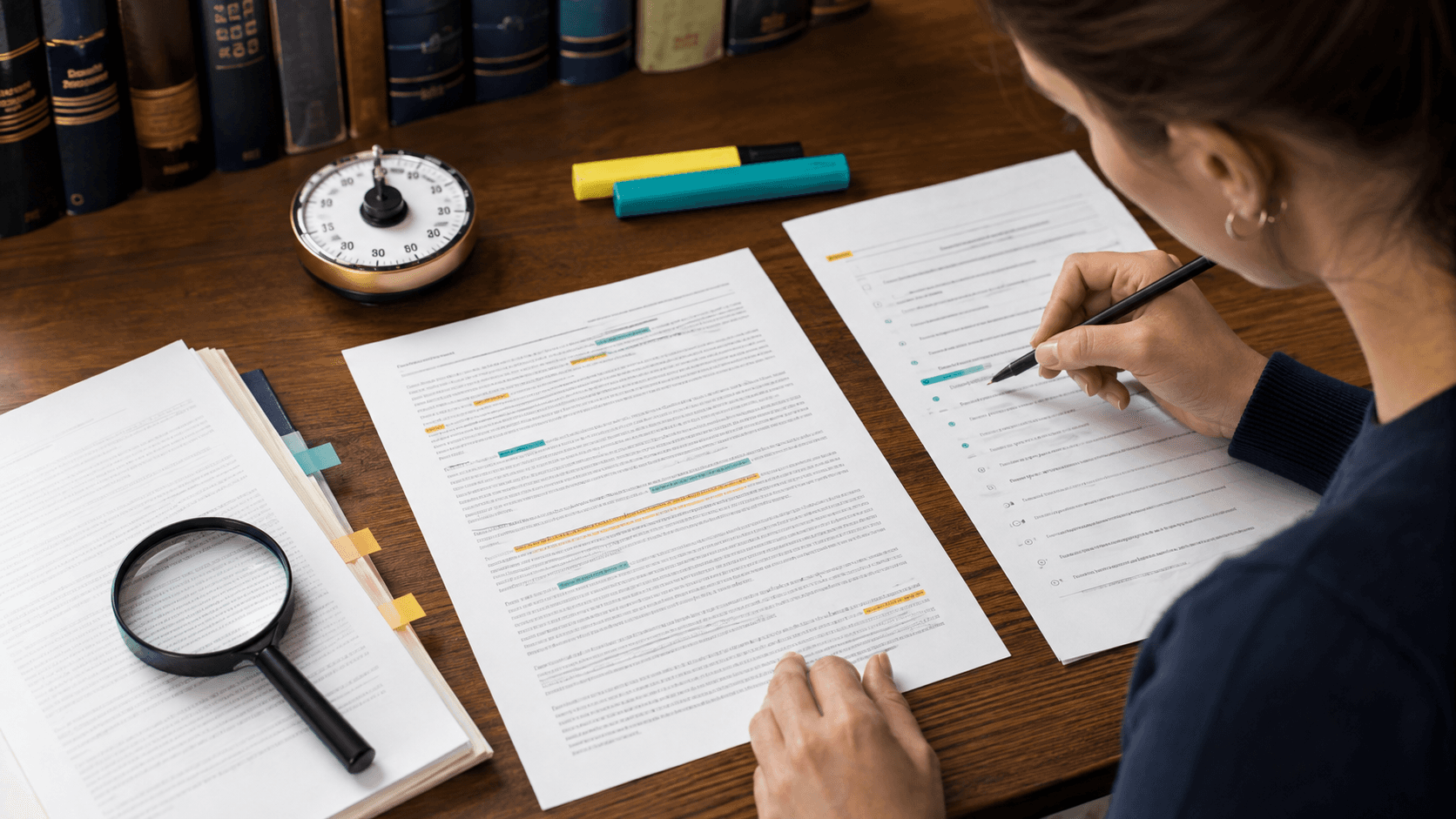
TEF Canada Reading Question Types: Find Evidence Without Translating Everything
PrepMyFrench Education Team
13 min read
TEF Canada Reading Question Types: Find Evidence Without Translating Everything
TEF Canada reading is not a translation contest. It is a timed evidence-selection test.
You have to determine what a document means, why it was written, how its ideas connect, and which answer is supported—without converting every sentence into English.
The current official format contains 40 multiple-choice questions in 60 minutes. You may navigate freely within the reading questionnaire, and correct answers receive one point while wrong or unanswered responses receive zero. See the official TEF Canada test-day description.
This guide gives you an evidence method that works across the major question families.
Teachers
Book a session with a PrepMyFrench teacher
Jerry and our affiliated teachers run 1:1 exam sessions you can book from this page. Advanced candidates can also book a pathway consultation.
These include advertisements, schedules, instructions, messages, signs, and short notices.
The task often asks who the document is for, what action is required, when something happens, or what service is offered.
Best approach
Read in layers:
Document type and source
Headline or opening line
Dates, prices, conditions, and restrictions
The precise detail requested
Do not read a timetable like an opinion article. Scan its structure.
Common trap
An option repeats a service named in the document but ignores a condition such as uniquement sur réservation or à partir de lundi.
Question family 2: communicative purpose
The question may effectively ask: Why was this text written?
Possible purposes include informing, warning, requesting, apologizing, persuading, complaining, inviting, or explaining.
Evidence to use
Look at the relationship between sender and receiver, the requested action, and the final sentence. A text can contain information while its main purpose is to persuade the reader to register.
Useful distinction
Topic answers “What is this about?”
Purpose answers “What does the writer want this document to accomplish?”
Confusing them produces many wrong answers.
Limited Offer
Aiming for CLB 7+?
Join 15,000+ candidates efficiently preparing with our AI-powered simulator.
A main-idea answer must cover the central claim without becoming too broad or too narrow.
Three-test filter
Ask whether the option:
Covers most of the document
Reflects the author's emphasis
Avoids adding a claim the text never makes
An example from paragraph two is usually too narrow. A sweeping social conclusion may be too broad.
Question family 4: explicit detail
These questions appear simple, but distractors manipulate nearby facts.
Method
Convert the question into an anchor. If it asks why a project was postponed, search for the project and causal language. Read the sentence before and after the anchor because pronouns and contrast often alter meaning.
Common traps
Correct number, wrong category
Correct person, wrong action
Initial date instead of revised date
Cause confused with consequence
Example confused with general rule
Limited Offer
Aiming for CLB 7+?
Join 15,000+ candidates efficiently preparing with our AI-powered simulator.
Advanced questions often test the relationship between sentences or paragraphs:
Cause
Consequence
Contrast
Concession
Addition
Illustration
Condition
Purpose
High-value markers
Do not memorize connectors as translations only. Learn the relation they create.
Question family 8: inference
Inference means choosing a conclusion that must or probably follows from the text. It does not permit invention.
The one-step rule
A safe inference is usually one logical step beyond explicit evidence.
If a company extends remote work after a successful trial, you can infer that management found the trial sufficiently positive. You cannot infer that every employee prefers remote work unless the text says so.
Eliminate overstatement
Distractors often contain absolute language: always, never, everyone, completely, the only reason. If the text is cautious, the answer should preserve that caution.
Limited Offer
Aiming for CLB 7+?
Join 15,000+ candidates efficiently preparing with our AI-powered simulator.
An author may be supportive, critical, skeptical, nuanced, enthusiastic, worried, or neutral. Modal verbs, adjectives, adverbs, punctuation, and concessions reveal stance.
Compare:
Cette mesure résoudra le problème. — confident
Cette mesure pourrait atténuer le problème. — cautious
Cette prétendue solution ignore l'essentiel. — critical
Degree matters. “Concerned” is not the same as “furious.”
Question family 10: sentence insertion and cohesion
Some items test where a sentence fits or how a document holds together.
Four cohesion clues
Pronouns need an antecedent.
Connectors need a logical relationship.
Repeated vocabulary maintains the topic.
Time expressions preserve chronology.
A sentence beginning Cette décision cannot normally appear before any decision has been introduced.
Limited Offer
Aiming for CLB 7+?
Join 15,000+ candidates efficiently preparing with our AI-powered simulator.
Most wrong options belong to a small number of types:
Distractor
What it does
Keyword echo
Repeats words but changes the meaning
Reversal
Swaps cause/effect, before/after, or support/opposition
Overstatement
Turns some into all, may into certainly
True but irrelevant
States a real detail that does not answer the question
Unsupported inference
Adds plausible outside knowledge
Scope error
Uses one example as the main idea
During review, label the distractor you chose. This is more valuable than simply recording that B was correct.
A realistic time-management system
Question difficulty generally increases, but your own strengths matter. Use three passes.
Pass 1: secure direct evidence
Answer short practical documents and clear detail questions efficiently. Bank time without rushing carelessly.
Pass 2: manage medium-complexity texts
Use paragraph structure and anchors. Aim for a supported choice, not a perfect translation.
Pass 3: control the hardest items
Leave enough time for inference, tone, and dense argumentative texts. If two options remain, identify the exact word or relationship that separates them.
Reserve a final review window for flagged questions. Because the official computer questionnaire currently allows navigation, use that flexibility deliberately.
Limited Offer
Aiming for CLB 7+?
Join 15,000+ candidates efficiently preparing with our AI-powered simulator.
For short practical documents, reading the question first often gives you an efficient search target. For longer argumentative texts, quickly establish the topic and structure, then use the question to locate evidence.
Can I return to previous TEF reading questions?
The current official computer-based description says candidates may navigate freely within the reading questionnaire. Follow the instructions presented at your test center.
Is there negative marking?
The official provider currently states that correct answers receive one raw point and wrong or unanswered questions receive zero.
Should I use a dictionary while practicing?
Use it during analysis, not during the timed attempt. First infer meaning and answer under exam conditions; then verify vocabulary.
How can I read faster?
Reading faster comes from recognizing document structure, common phrases, and logical relationships—not forcing your eyes to move quickly while comprehension collapses.
The final principle
Every correct reading answer should be defensible with evidence. If your explanation is “it sounded right,” your process cannot be repeated. If your explanation is “the second paragraph contrasts the original plan with the final decision,” you have a method.
Stop translating everything. Start proving one answer.