Last updated: 3 أغسطس 2026
Confusing French Verbs: The "M-O-T-S" Disambiguation Framework
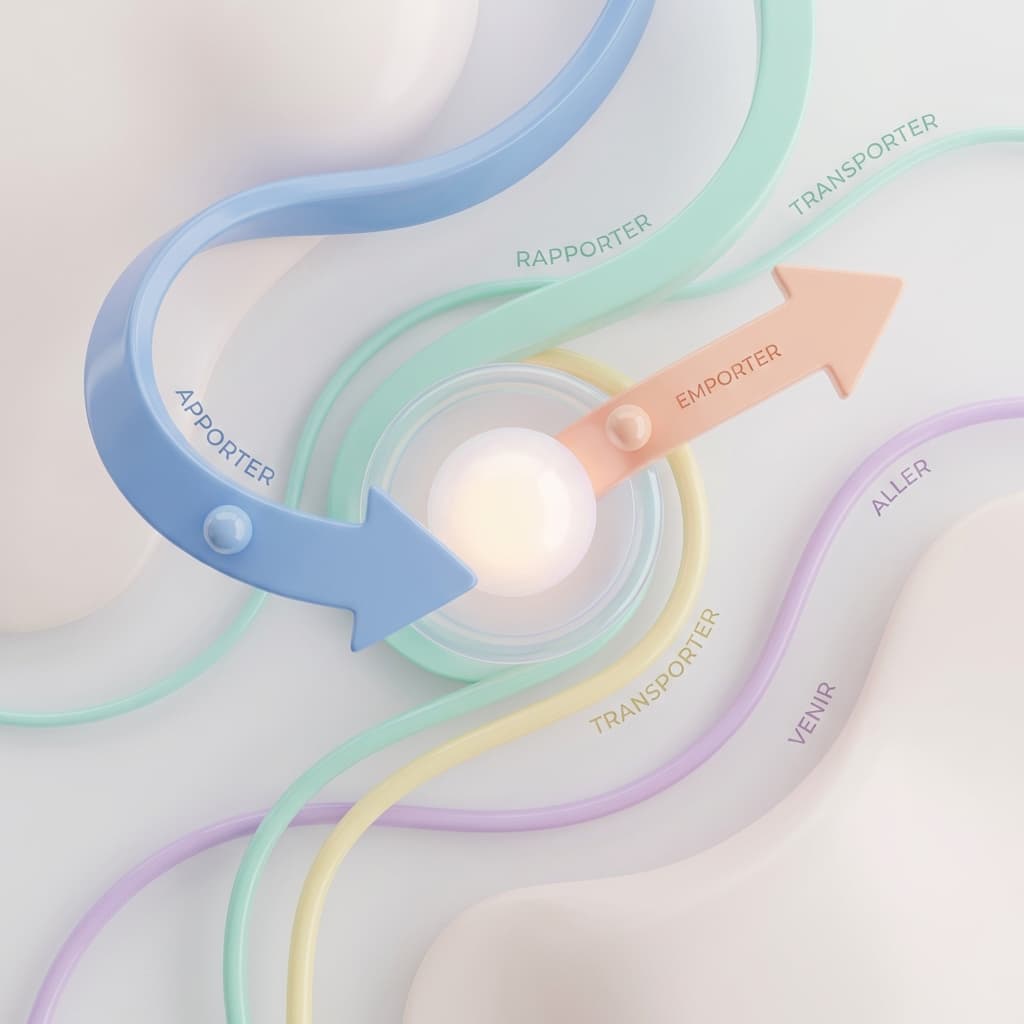
Confusing French Verbs: The "M-O-T-S" Disambiguation Framework
One of the fastest ways to lose points in the TEF or TCF Canada Speaking exams is to misuse a common French verb pair.
In English, one verb can cover multiple situations (e.g., "to bring" or "to know"). In French, however, verbs are highly specific to the context. If you say "J'ai amené mon ordinateur" (I brought my computer), a native speaker will immediately cringe, and your grammatical precision score will plummet.
To achieve a CLB 9+ (C1/C2), you must master these subtle semantic differences. To stop translating from English and start using French verbs accurately, use our M-O-T-S Disambiguation Framework.
What is the M-O-T-S Framework?
The M-O-T-S framework helps you logically distinguish between the four most commonly confused verb pairs that trap candidates during the exam:
- M - Mouvement (Movement): Amener vs. Apporter (To bring).
- O - Objet (The Object Rule): Savoir vs. Connaître (To know).
- T - Temps (Time & Duration): Visiter vs. Rendre visite (To visit).
- S - Sens (Sense & Direction): Entendre vs. Écouter (To hear/listen).
Let's dissect these pairs so you never make these errors again.
1. M - Mouvement (Amener vs. Apporter)
Both verbs mean "to bring," but the French distinguish strictly between bringing people/animals and bringing inanimate objects.
- AMENER (To bring a person or animal): Think of the root mener (to lead). You lead things that can walk.
- J'amène mes enfants à l'école. (I bring my children to school.)
- Il a amené son chien au parc. (He brought his dog to the park.)
- APPORTER (To bring an inanimate object): Think of the root porter (to carry). You carry things that cannot move themselves.
- J'apporte une bouteille de vin au dîner. (I am bringing a bottle of wine to dinner.)
- N'oublie pas d'apporter ton ordinateur. (Don't forget to bring your computer.)
Aiming for CLB 7+?
Join 15,000+ candidates efficiently preparing with our AI-powered simulator.
No credit card required • Join now
2. O - Objet (Savoir vs. Connaître)
Both verbs mean "to know," but they are governed by strict grammatical object rules.
- CONNAÎTRE (To be acquainted with): This verb is always followed by a direct object noun (a person, a place, or a thing). It is never followed by a verb or a clause.
- Je connais Paris très bien. (I know Paris very well.)
- Elle connaît le directeur de l'entreprise. (She knows the director of the company.)
- SAVOIR (To know a fact or how to do something): This verb is followed by a verb (infinitive), a fact, or a subordinate clause (que, qui, où, quand).
- Je sais nager. (I know how to swim.)
- Je sais qu'il est en retard. (I know that he is late.)
- Sais-tu où est la gare ? (Do you know where the station is?)
3. T - Temps & Personnes (Visiter vs. Rendre visite)
This is a classic trap for English speakers. In English, you can "visit" a museum or "visit" your grandmother. In French, you cannot.
- VISITER (To visit a place): You only use visiter for physical locations, cities, or monuments. You are inspecting the space.
- Nous avons visité le musée du Louvre. (We visited the Louvre museum.)
- Je veux visiter le Canada. (I want to visit Canada.)
- RENDRE VISITE À (To visit a person): You must use this expression when talking about people. If you say "Je vais visiter ma grand-mère", it sounds like you are going to physically inspect her organs.
- Je vais rendre visite à ma grand-mère ce week-end. (I am going to visit my grandmother this weekend.)
- Il a rendu visite à ses amis. (He visited his friends.)
Aiming for CLB 7+?
Join 15,000+ candidates efficiently preparing with our AI-powered simulator.
No credit card required • Join now
4. S - Sens (Entendre vs. Écouter)
Both involve your ears, but one is passive and the other is active.
- ENTENDRE (To hear - Passive): This is the physical ability of your ear to pick up a sound, even if you aren't trying to.
- J'entends le bruit de la circulation. (I hear the noise of the traffic.)
- Je ne t'entends pas bien, la connexion est mauvaise. (I can't hear you well, the connection is bad.)
- ÉCOUTER (To listen - Active): This requires focus and intention. You are paying attention to the sound.
- J'écoute de la musique classique. (I am listening to classical music.)
- Il n'écoute jamais les conseils de son professeur. (He never listens to his teacher's advice.)
Stop Translating, Start Thinking in French
The M-O-T-S framework clarifies the rules, but under the extreme pressure of the Speaking exam, you will default to your native language habits. You need these verb distinctions to become automatic reflexes.
Automate Your Vocabulary with Live French Classes!
Are you tired of losing points because of direct translations from English? Do you want to speak with native-level precision? Join our highly popular Live Zoom French Classes! Taught by our expert instructor Guillaume, these classes drill precision into your muscle memory:
- Structured Progression: Move seamlessly from A1 (Beginner) $\rightarrow$ A2 (Elementary) $\rightarrow$ B1 (Intermediate) to build a bulletproof grammatical and lexical foundation.
- Live Speaking Drills: Stop doing silent worksheets. In our Zoom classes, Guillaume runs rapid-fire speaking drills, instantly correcting your verb choices (amener vs apporter) until they flow naturally in conversation.
- Interactive Format: 3 sessions per week (Thursday, Friday & Saturday) via Zoom, allowing for rich, peer-to-peer roleplays.
- Upcoming Cohorts: Our Summer Cohort launches June 4. If you are ready for advanced vocabulary automation, join our B1 Exclusive Batch starting May 21.
- Flexible Packages & Massive Savings:
- Individual Levels: A1 ($150 CAD), A2 ($180 CAD), B1 ($270 CAD).
- A1 + A2 Bundle: 18 weeks of comprehensive study for just $250 CAD (Save $80!).
- A2 + B1 Bundle: 24 weeks of intermediate immersion for $400 CAD (Save $50!).
- All-Inclusive Combo (A1 + A2 + B1): 33 weeks of complete exam preparation for only $500 CAD (Save $100!).
Stop letting basic verbs ruin your advanced score. Secure your seat in our June 4 Summer Cohort today and perfect your precision!